

Many property owners view water tank cleaning as a “grudge purchase.” It is an unexciting expense for a utility hidden on a roof or buried in a basement—a problem unseen and easily deferred in favor of cosmetic renovations. The rationalization is seductive: “The water looks clear, so why bother?”
This “out of sight, out of mind” attitude is a financial miscalculation. Viewing water tank maintenance as discretionary is penny-wise and pound-foolish; it is not a saving, but an active liability. Deferring maintenance creates a cascade of failures, transforming minimal proactive costs into major capital expenses.
By ignoring routine maintenance, you take out a high-interest loan against your property’s future. The interest accrues as damaged plumbing, health hazards, and premature system failure. This accumulation is the true cost of neglect. At KiTank Cleaning, we see firsthand how a “save money now” mindset leads to “spend a fortune later” disasters. A dirty, neglected water tank is not merely a hygiene issue; it is a significant financial risk.
This guide demonstrates the severe consequences of deferring this critical task. We break down the true cost of neglect, illustrating precisely why skipping a professional water tank clean costs far more in the long run than the minimal expense of proactive care.
Health Costs and Medical Bills: The Price of Contaminated Water
The most immediate consequence of a neglected water tank is the risk to human health. Even if municipal supply is treated, sediment (dust, rust, and organic matter) inevitably settle at the bottom of your tank. This sludge consumes the residual chlorine meant to protect you, allowing a hidden ecosystem of dangerous pathogens to flourish. Your tank transforms from a storage vessel into a petri dish.
Clear Water is a Liar: The Unseen Invaders
The water from your tap looks perfectly clear, so your tank must be clean, right? Clarity does not guarantee purity. The real danger is microscopic. Inside a neglected tank, two critical failures occur that turn your water source into a liability:
- The Sludge Layer: This accumulation of sediment acts as a nutrient-rich buffet for bacteria and protozoa.
- The Biofilm: Bacteria secrete a slimy, glue-like substance to anchor themselves to the tank’s inner walls. This protective shield defends pathogens against disinfectants, allowing them to persist and multiply.
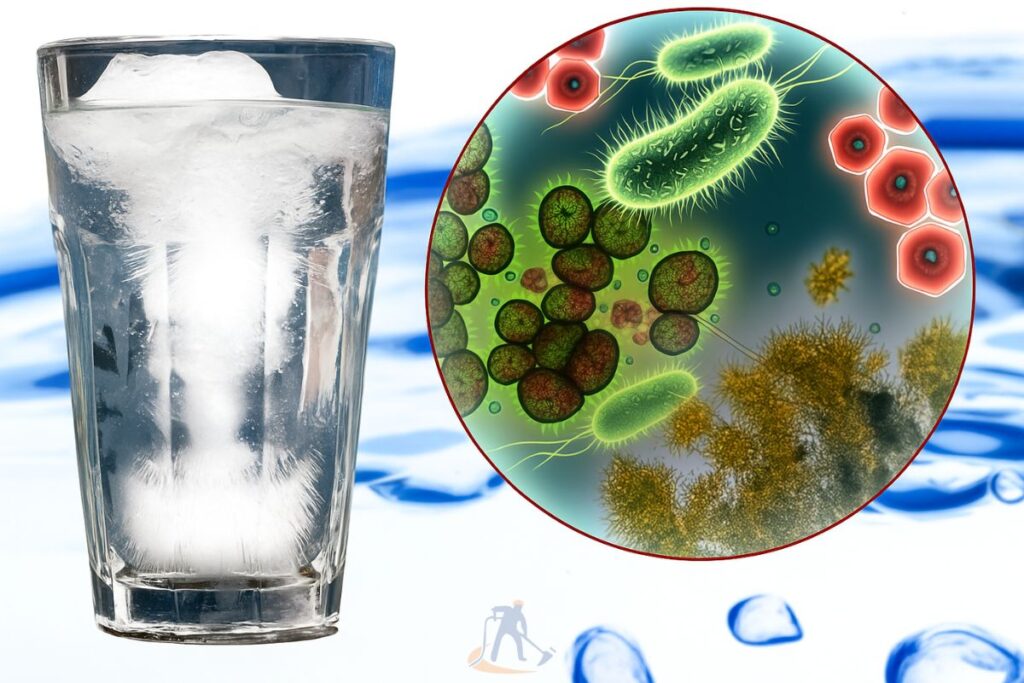
“Water storage is often a source of contamination, as fungi and bacteria build up in the form of slime (biofilms). These pathogens are spread through direct contact with the water, making the tank a critical point of failure for household hygiene.” — Olga Mashedi, Research Scientist
Exposure to contaminated water leads to severe health issues:
- Gastrointestinal Illnesses: E. coli, Salmonella, and Giardia can cause severe symptoms like diarrhea, vomiting, stomach cramps, and fever.
- Respiratory Infections: Inhaling mist from a shower or other water source contaminated with Legionella bacteria can lead to Legionnaires’ Disease, a serious form of pneumonia requiring prompt medical treatment.
- Skin and Hair Problems: Bathing in contaminated water can cause skin rashes, eczema flare-ups, folliculitis, and eye irritation.
The Real Cost of Sickness
The health risks of a dirty water tank translate directly into significant, unplanned expenses. When a family member falls ill, the costs accumulate rapidly beyond a simple pharmacy visit.
Estimated Cost of Treating a Single Waterborne Illness in Kenya:
| Item | Description | Estimated Cost (KSh) |
| Initial Doctor Visit | Consultation and examination | 2,000 – 4,000 |
| Pathogen Testing | Stool culture or blood work | 3,000 – 6,000 |
| Medication | Antibiotics, anti-diarrheals, fluids | 1,500 – 3,000 |
| Missed Wages (3 Days) | Lost income due to sickness | 2,500 – 7,500+ |
| TOTAL ESTIMATED EXPENSE | For a single case of illness | 9,000 – 20,500+ |
The financial strain multiplies through indirect costs. If an adult suffers from typhoid, they may miss weeks of work. If a child is sick, a parent often takes unpaid leave to provide care, doubling the household income loss.
The “Trust Tax”: The Hidden Cost of Bottled Water
There is another insidious cost to neglect: the Trust Tax. When you suspect your tank is dirty, perhaps due to an off smell or simply fear of contamination, you lose faith in the quality of your tap water.
Many people opt for expensive bottled water for all their drinking and cooking needs rather than addressing the problem at the source (professional tank cleaning). Although it offers a perceived sense of safety, this approach is both costly and unsustainable. This decision carries a significant annual financial burden.
The Annualized “Trust Tax”: Cost Analysis for a Nairobi Household (Estimates)
- Assumptions (for illustration):
- Household size: 4 people.
- Daily Water Need: ~10-15 liters (drinking/cooking).
- Bottled Water Price: A 5L bottle might cost KSh 100-200; smaller bottles more. Let’s use an average of KSh 150/5L = KSh 30/L.
- Annual Consumption: 12L/day * 365 days = 4380 Liters/year.
- Annual Bottled Water Cost: 4380 Liters * KSh 30/L = KSh ~131,400 per year.
By relying on bottled water because you lack confidence in your storage system, you pay a recurring tax up to six times higher than the cost of a professional water tank cleaning service.
Regular maintenance and testing of your water tank serves as an insurance policy against medical expenses, lost productivity, and the high cost of bottled water alternatives.
Maintenance Costs: Plumbing, Appliance, and Infrastructure Damage
While health risks are the primary concern, property damage from a neglected tank is often the most immediate financial shock. Sludge, sediment, and corrosive agents act as silent assassins, relentlessly degrading plumbing and appliances.
The grit and rust in a dirty tank do not stay static; they are drawn into your water system, acting like liquid sandpaper on every component they touch. This is how the avoidable cost of a tank cleaning snowballs into catastrophic failure.
1. Water Management System Failure (Pumps & Pipes)
Destruction begins the moment water leaves your tank. Sediment is the nemesis of your home’s hydraulic systems.
- Pressure Pump Burnout: In many Kenyan households, a booster pump is a vital necessity. When abrasive grit enters the intake, it grinds down impellers and destroys seals, forcing the motor to strain and eventually burn out. A water pump replacement costs between KSh 15,000 and KSh 80,000.
- Corrosion and Leaks: Accumulated organic matter releases acidic byproducts. This chemical attack causes pitting corrosion in metal pipes, leading to pinhole leaks. A hidden leak inside a wall does more than waste water; it causes structural damage and mould growth. Remediation can cost KSh 15,000 to KSh 50,000, a claim insurance companies often reject if they attribute it to maintenance neglect.
- Clogs and Low Pressure: Limescale and biofilm clog faucet aerators and showerheads, drastically reducing water pressure and requiring professional descaling.
2. Accelerated Appliance Damage
Sediment flows into every water-reliant appliance, reducing efficiency and accelerating failure.
- Water Heaters (Geysers): Sediment is particularly destructive here. It settles at the bottom of the heater, forming an insulating layer over the heating element. The unit must work overtime to heat water, inflating your electricity bill and causing the element to overheat and fail. A full geyser replacement costs between KSh 20,000 and KSh 50,000+.
- Washing Machines & Dishwashers: Abrasive grit clogs delicate inlet valves, while limescale coats internal heating elements. This leads to poor performance and mechanical failure, with repairs costing up to KSh 25,000.
3. The Ultimate Expense: Premature Tank Replacement
The most expensive outcome of neglect is the need for complete tank replacement. A well-maintained tank can last 15–25 years; a neglected one may fail in 8–12.
- Accelerated Corrosion: The anaerobic (oxygen-free) pockets created by settled sludge aggressively attack the tank’s structure. In concrete tanks, bacteria produce sulfuric acid that eats away at the cement (Microbially Induced Corrosion).
- Masked Defects: A thick layer of sludge hides developing cracks that could have been repaired cheaply (KSh 2,000) before becoming catastrophic failures.
A new plastic tank can cost between KSh 15,000 and KSh 45,000, while larger concrete or steel options can run into the hundreds of thousands of Kenyan Shillings. Repairing or relining a tank is almost always a fraction of the cost of replacement.
Financial Breakdown of Reactive Repairs
When maintenance is ignored, the costs escalate rapidly due to the nature of emergency services and the severity of the damage.
Typical Reactive Repair Estimates
| Failure Type | Estimated Cost (KSh) |
| Emergency Plumbing Call-Out | 5,000 – 15,000 |
| Water Pump Replacement | 15,000 – 80,000 |
| Water Heater Replacement | 25,000 – 50,000 |
| Structural Damage (Leaks) | 15,000 – 50,000+ |
| Full Water Tank Replacement | 20,000 – 100,000+ |
| TOTAL POTENTIAL LIABILITY | Staggering Multi-Issue Crisis |
“Preventative Maintenance is always cheaper than Curative Maintenance. A KSh 5,000 cleaning today can save a KSh 50,000 repair next month. Adopting a proactive approach through a comprehensive water tank maintenance plan is the single most cost-effective strategy to protect your property.”
Financial & Liability Costs: Legalities, Insurance, and Property Value
Neglecting water tank maintenance presents significant risks to both homeowners and business owners, with consequences spanning legal liabilities, and diminished property values.
1. Legal and Regulatory Liabilities
Property owners, especially commercial ones, are often required to comply with specific health and safety standards and local government water quality regulations. Violations carry severe consequences:
- Fines and Penalties: In Kenya, businesses found in violation of water quality standards face penalties exceeding KES 2 million per violation.
- Operational Shutdowns: Health authorities can order the immediate closure of a facility until remediation is complete, leading to unrecoverable revenue loss.
- Legal Liability: If contaminated water causes illness among tenants or customers, property owners face expensive personal injury lawsuits.
- Reputational Damage: A public incident of contamination or a health department closure instantly destroys customer trust.
2. Impact on Property Value
The condition of your water system directly impacts the value of your most significant asset: your property.
- Decreased Market Value: The presence of a history of contamination, or even the perception of poor water quality, can significantly lower a property’s market value. Buyers and tenants are often willing to pay a premium for properties with access to high-quality, safe water, and conversely, avoid those with known issues.
- Insurance Claim Denials: Most homeowners and commercial property insurance policies have limitations regarding damages stemming from negligence or poor maintenance. If a plumbing or tank issue that could have been prevented (like corrosion from built-up sediment) leads to significant damage, the repair costs might not be covered, resulting in substantial out-of-pocket expenses.
Prioritizing regular, professional water tank maintenance is a prudent financial and legal strategy to safeguard the well-being of occupants, ensure compliance with health standards, and preserves the long-term value of your investment.
The Proactive Choice: The Affordable, Fixed Cost of Professional Maintenance
Regular water tank cleaning is a cost-effective preventive measure that significantly outweighs the potentially substantial costs and serious risks associated with neglect.
Estimated Professional Cleaning Costs in Kenya
The cost of professional water tank cleaning in Kenya varies depending on location, tank size, and service provider, but it’s a relatively affordable, predictable, and manageable investment.
| Tank Capacity (Liters) | Use Case | Est. Cost (KSh) |
| 500L – 2,000L | Small Households / Apts | 3,000 – 6,000 |
| 2,000L – 10,000L | Large Homes / Small Biz | 6,000 – 15,000 |
| 10,000L – 50,000L | Commercial / Estates | 8,000 – 35,000+ |
| 50,000L+ | Industrial / Institutional | Custom Quote |
For comprehensive asset protection, minor additional services like crack sealing (KSh 2,000–5,000) or water quality testing (KSh 2,000–5,000) offer high-return value for a minimal added cost.
💡 Pro-Tip: Many service providers offer discounts for scheduled, routine cleaning as part of an annual maintenance contract, making it even more cost-effective over time.
The ROI of Professional Maintenance
Investing in low-cost, regular water tank cleaning yields tangible returns. It functions less as an expense and more as an essential safeguard for your health and infrastructure. The primary ROI is realized through thousands of shillings saved on emergency repairs, lower utility bills, and extended appliance lifespans—plus the invaluable peace of mind that comes from a reliable, healthy water supply.
The KiTank Difference: Why Professional Service is Superior
While basic maintenance has its place, the “KiTank Difference” delivers a level of sanitation and safety that transforms water quality from “visually clean” to clinically safe. Hiring a professional is a strategic move that delivers efficiency, safety, and guaranteed results.

The Hidden Risks of DIY
Attempting a DIY clean often fails to address root causes and can worsen water quality via the “churn effect.” Without industrial suction, manual scrubbing simply dislodges sediment rather than removing it.
- Incomplete Cleaning: DIY often leaves behind harmful bacteria and biofilm.
- Safety Hazards: Risks include falls, chemical exposure, and working in confined spaces.
- The Cost of Neglect: Ineffective cleaning leads to recurring cycles of contamination and compromised health.
KiTank’s Core Advantages: The Investment in Purity
Our comprehensive cleaning process ensures you realize the full economic benefits of your water system:
- Expertise & Uncompromised Safety: Our technicians use proper Personal Protective Equipment (PPE) and are trained for confined spaces and height safety, mitigating risks homeowners shouldn’t face.
- Advanced Equipment: We utilize high-pressure jet washers and industrial sludge vacuums to completely eradicate biofilm that standard buckets and brushes cannot reach.
- Clinical Disinfection: We go beyond household bleach, using NEMA-compliant, food-grade disinfectants and UV/Ozone treatments to ensure maximum pathogen elimination.
- Convenience & Compliance: We handle the mess and dispose of waste strictly according to environmental standards.
Our core value of KiTank Cleaning is reliability. We offer a guaranteed, hassle-free solution. By choosing professional care, you avoid the inconsistent, risky, and effort-intensive alternative of DIY or the dangerous path of neglect. We safeguard your health and finances with a level of expertise that homeowners simply cannot replicate.
Conclusion: Stop Paying the “Neglect Tax”
The “savings” you get from skipping a professional water tank clean are an illusion. They are a debt accrued with high interest against your family’s health and your property’s infrastructure. When you tally the potential costs of medical emergencies, damaged appliances, inflated energy bills, and plummeted property value, the price of neglect becomes undeniable.
Proactive maintenance is not an expense; it is an investment in certainty.

Don’t wait for a crisis. Secure your water supply and protect your wallet from the steep financial and health consequences of water tank neglect.
KiTank Cleaning provides professional, hygienic, and affordable services throughout Nairobi guaranteeing the efficiency of your water system.
Contact KiTank Cleaning Services for a Free Consultation & Quote:
- Call / WhatsApp: 0729 735 245 (24/7 Emergency Support Available)
- [Get a Personalized Quote Online]
Schedule your professional cleaning today and save thousands in the long run.
