
In Kenya, access to clean, safe water is more than a convenience—it’s a constitutional right and a fundamental health requirement. While water storage tanks are essential for ensuring a consistent supply, a neglected tank can quickly become a serious liability, breeding harmful bacteria and putting your family, tenants, or customers at risk of waterborne disease.
For homeowners, landlords, and business managers, the responsibility is clear. You are required to ensure the water you store and provide is safe. But navigating the web of laws, standards, and best practices can be confusing.
This guide provides a clear, comprehensive overview of the regulations, standards, practical steps and best practices for water tank cleaning in Kenya. It will empower you to protect your community, maintain your property, and ensure you are fully compliant with national laws.
Why Clean Your Water Tank? The Health & Legal Risks
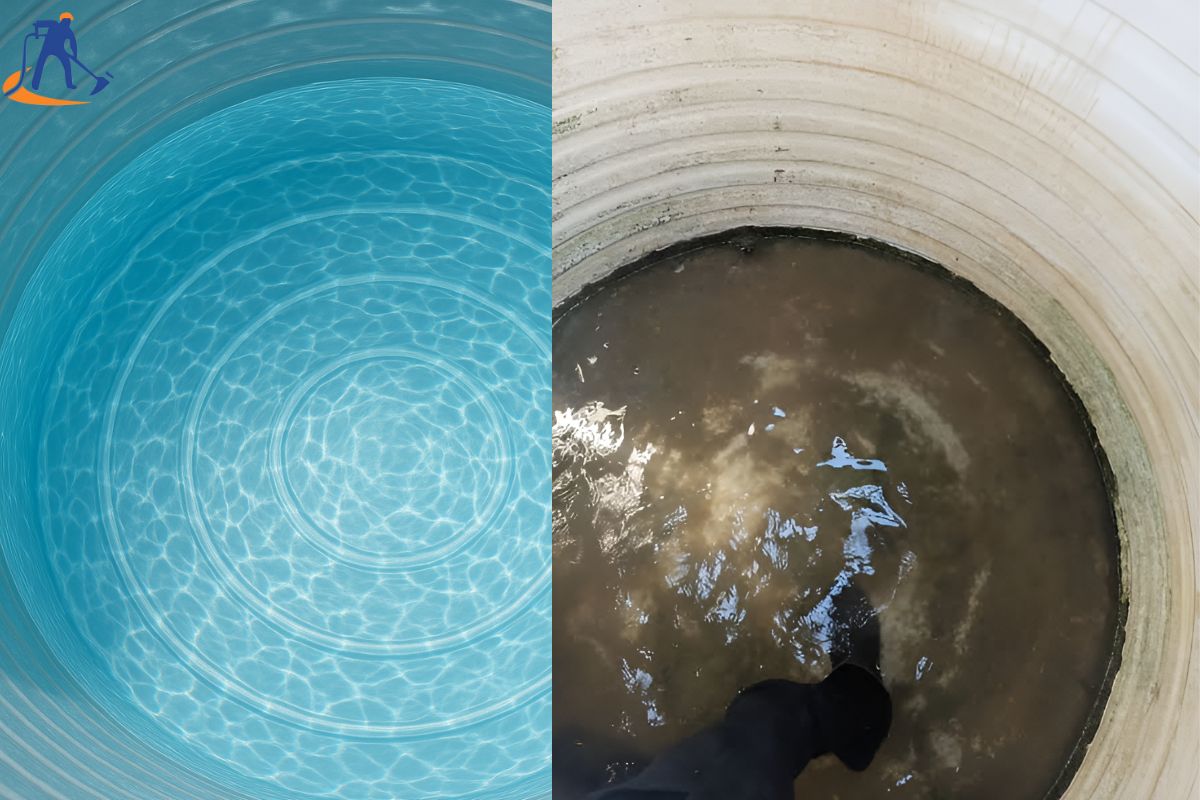
Before diving into regulations, it’s crucial to understand what’s at stake. Neglecting your water tank invites serious health risks and legal penalties. In Kenya, regular cleaning is essential to safeguard public health, prevent deadly waterborne diseases, and comply with the law.
- Protect Public Health: Contaminated water is a primary cause of waterborne diseases. Dirty tanks can harbor harmful bacteria and viruses, leading to diseases like cholera, typhoid, dysentery, and legionnaires’ disease. In 2023, Kenya reported over 11,000 cholera cases, a disease closely linked to unsafe water and sanitation practices. Regular, thorough cleaning is the most effective first line of defense to protect your family, tenants, or employees.
- Your Legal Responsibility: Kenya’s Public Health Act (Cap 242) defines an unclean water tank as a “nuisance.” This makes property owners legally responsible for maintaining their water storage systems. If contaminated water from your tank causes illness, you can be held liable.
- Protecting Your Investment: Sediment and corrosion can damage your tank, leading to costly repairs and water loss. Proper maintenance extends the life of your tank, preserves the clean taste of your water, and prevents environmental contamination from leaks.
Hiring a professional cleaning service is the most reliable way to achieve a safe and compliant standard. Professionals ensure compliance, achieve proper disinfection, maintain optimal water quality, and provide peace of mind regarding the safety and reliability of your water supply.
Penalties for water-related offences vary based on the specific infraction and applicable laws. General violations of water regulations can lead to fines of up to KSh 500,000. More serious offenses, such as illegal water connections, can result in fines of KSh 30,000 for individuals and KSh 100,000 for institutions.
The Legal Framework: Kenya’s Water Regulations & Standards for Water Tank Cleaning
Homeowners and property managers commonly ask: “Is there a specific law for water tank cleaning in Kenya?”
While there is no single law titled “The Water Tank Cleaning Act,” a robust framework of national laws, technical standards, and county by-laws creates a clear legal responsibility for property owners to maintain safe water storage. If you own or manage a property with a water tank, you are legally obligated to ensure the water is safe for human consumption.
This responsibility is enforced through several key regulations:
- The Constitution of Kenya 2010 (Article 43)
- The Public Health Act (Cap 242)
- The Water Act 2016 (and WASREB’s role)
- NEMA (Environmental Management and Coordination Act, 1999)
- KEBS
- County Government By-Laws
1. The Constitution of Kenya 2010 (Article 43)
This foundational document guarantees every person the right to access clean and safe water in adequate amounts. This fundamental right underpins all subsequent water-related legislation and places a high implicit responsibility on anyone involved in water provision, including those storing water, to ensure its safety.
2. The Public Health Act (Cap 242): Your Legal Duty
This is the most critical piece of legislation for property owners.
- What it means for you: The Act defines an unclean water tank as a “nuisance” (Section 118), giving public health officers the authority to inspect your property and demand immediate cleaning.
- Your responsibility: You are legally required to prevent the pollution of drinking water sources (Section 130) and ensure your tank is securely covered (Section 139). Failure to do so can result in legal liability if someone falls ill from water on your property.
3. The Water Act 2016 and Water Services Regulatory Board (WASREB): Foundations for Water Quality and Safety
The Water Act 2016, and its predecessor, the Water Act (Cap 372), govern the management, conservation, and regulation of water resources and services. While it does not explicitly detail water tank cleaning procedures, it sets out the legal framework for water resource management, water services provision, and consumer protection.
while specific regulations for water tank cleaning might not be explicitly detailed in the Water Act or WASREB guidelines, they are implied under the broader framework of water services regulation and quality standards set by WASREB. This means that water service providers are expected to adhere to guidelines and standards set by WASREB,
- Cabinet Secretary Mandate: The Act mandates the Cabinet Secretary to formulate strategies for water services, which inherently includes ensuring the quality and safety of water throughout the supply chain, from source to tap.
- Water Resources Authority (WRA): Established under the Act, WRA is responsible for regulating the management and use of water resources. This includes overseeing water abstraction and ensuring sustainable water sources, which indirectly impacts the quality of water entering storage tanks.
- Water Services Regulatory Board (WASREB): Also established by the Water Act 2016, WASREB licenses Water Service Providers (WSPs), sets standards, and enforces rules to ensure consumers have access to efficient, affordable, and sustainable water services of reasonable quality. WASREB has a mechanism for handling consumer complaints regarding water quality and can take action against WSPs whose supply becomes contaminated, including issues related to storage.
4. NEMA Regulations: Responsible Waste Disposal
The National Environment Management Authority (NEMA) is responsible for overseeing water quality and environmental standards. NEMA enforces regulations stemming from the Environmental Management and Coordination Act (EMCA) of 1999, which includes the Environmental Management and Coordination (Water Quality) Regulations, 2006. These regulations aim to protect water resources and ensure public health by setting standards for water quality, and rules for water storage and discharge for various purposes like domestic, agricultural, and industrial activities.
Failing to comply with NEMA regulations can lead to fines, legal prosecution, or even the closure of facilities. Hiring a professional cleaning service like KiTank Cleaning ensures that tanks are thoroughly cleaned and sanitized. These professionals are equipped to handle waste disposal safely and by NEMA guidelines, which helps minimize the risk of penalties.
5. KEBS Standards: The Benchmark for Water Quality and Tank Maintenance
The Kenya Bureau of Standards (KEBS) establishes and enforces technical standards for a wide range of products and services, including water quality and cleaning products used in water tank maintenance. These standards ensure the safety of water by setting acceptable limits for various parameters, such as bacteria, pH, turbidity, and heavy metals.
Although KEBS does not have a specific standard dedicated exclusively to water tank cleaning, it does cover water quality through established standards such as KS 459-1:2007 for potable water. Additionally, KS EAS 12:2018 outlines specifications, sampling methods, and testing procedures for potable water intended for direct human consumption, as well as for domestic and industrial use.
- KS 459-1:2007 (Potable Water): This standard sets limits for various parameters in drinking water, including:
- Total Coliforms and E. coli: Must be absent.
- pH (Acidity/Alkalinity): Must be between 6.5 and 8.5.
- Turbidity: Should be low.
- Heavy Metals: Limits are set for substances like Lead, Mercury, and Arsenic.
A professional cleaning service ensures your water meets these critical benchmarks after service.
KEBS also has standards for water treatment chemicals and water storage tanks themselves, influencing hygienic design, requiring tanks to be hygienic, leak-proof, accessible, covered, and durable.
6. County Government By-Laws and Water Sanitation
In Kenya, county governments are responsible for implementing and enforcing local and national regulations related to water and sanitation within their jurisdictions. Under the authority of the Constitution and the County Governments Act, they create and enforce by-laws to ensure water tanks in homes, businesses, and public buildings are clean and well-maintained.
While national laws like the Public Health Act (Cap 242) provide a framework, counties tailor specific regulations to their local needs. This decentralized approach empowers them to manage public health effectively.
To ensure compliance, county public health officers inspect properties. Guided by Section 118 of the Public Health Act, their duty is to identify and correct any “nuisance” that could harm public health, such as a contaminated water tank.
Because these by-laws vary by county, you must consult your local Department of Health or Environment. They can provide specific requirements, such as cleaning schedules or lists of certified service providers.
Best Practices: The Professional Standard for Water Tank Cleaning
Adhering to best practices ensures your water is truly safe after cleaning.
How Often Should I Clean My Water Tank in Kenya?
Cleaning frequency depends on your water source, tank usage, and environment. We recommend the following schedule:
- Residential/Domestic Tanks: At least once every 6 to 12 months.
- Commercial/Industrial Tanks (e.g., hotels, schools, hospitals): Every 3 to 6 months due to higher water turnover and public health risk.
- Rainwater Harvesting Tanks: At least once every 6 months, especially after the rainy seasons to remove sediment and debris.
⚠️ Important: Schedule an immediate water tank cleaning if you notice cloudy water, a strange taste or smell, or visible slime or debris in the tank.
The Professional Cleaning & Disinfection Process
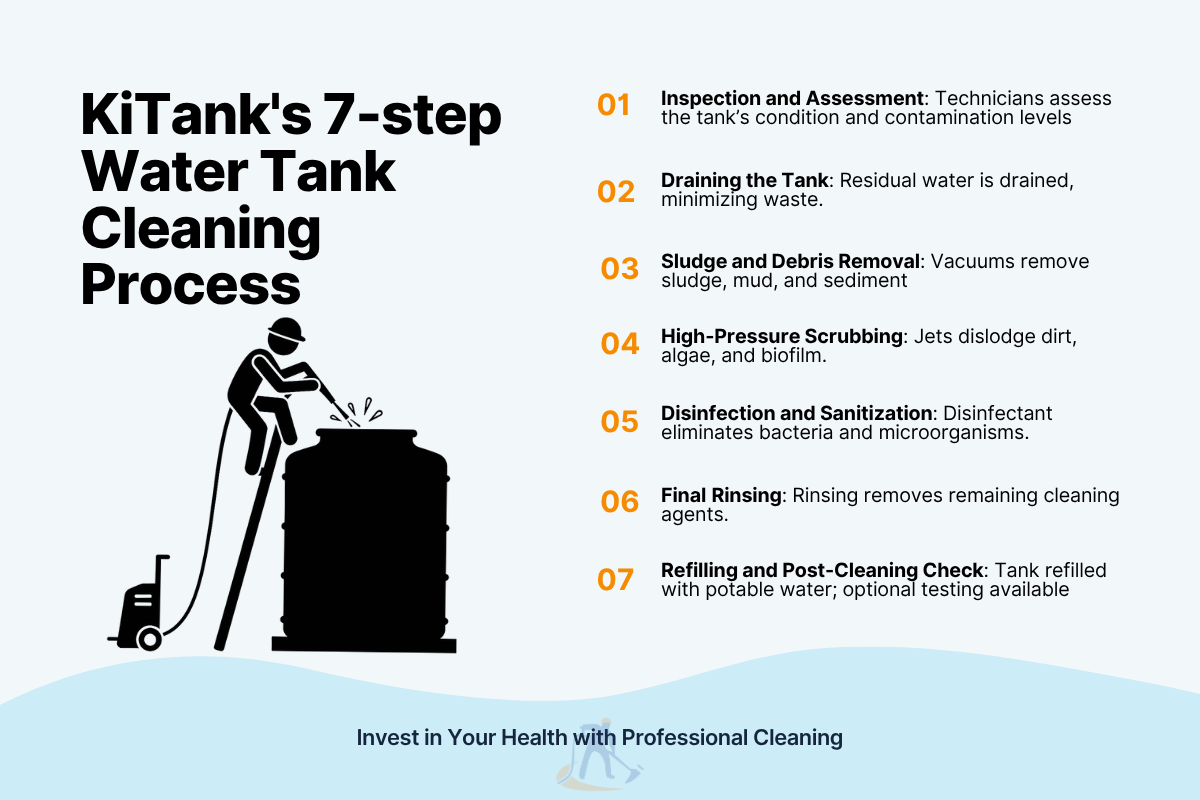
A professional cleaning service guarantees safety and compliance through a systematic process. A reputable company like KiTank Cleaning Services follows these essential steps:
- Safety & Inspection: The area is secured, safety protocols for confined space entry are established, and the tank’s condition is assessed.
- Draining: The tank is fully drained, with care taken to prevent sludge from entering your pipes.
- Sludge Removal: All physical debris, mud, and sediment are meticulously removed from the tank floor and walls.
- High-Pressure Washing: The interior surfaces are blasted with high-pressure water jets to strip away stubborn grime and, crucially, the resilient biofilm layer that harbors bacteria.
- Disinfection: A food-grade, KEBS-approved disinfectant (like a specific chlorine solution) is applied to all surfaces to eradicate any remaining microorganisms.
- Final Rinsing: The tank is thoroughly rinsed multiple times with clean water to remove all traces of disinfectant, ensuring the water is safe for consumption.
- Refilling & Documentation: The tank is safely refilled, and you are provided with a service certificate for your records.
Read more: KiTank’s Compliant Water Tank Cleaning Process
Post-Cleaning Water Testing
How can you be certain your water is safe after a cleaning? Through laboratory testing. A reputable cleaning service can facilitate taking a water sample post-cleaning to a KENAS-accredited lab. The resulting Certificate of Analysis is your definitive proof that the water meets KEBS standards, which is invaluable for businesses, schools, and hospitals.
DIY vs. Professional Service Comparison
Attempting to clean a tank yourself can be ineffective and dangerous. Here’s a clear comparison:
| Aspect | Unsafe DIY Practice (High Risk) | KiTank’s Professional Method (Safe & Compliant) |
| Disinfection | Uses household soap or improper amounts of Jik, leaving residue or failing to kill germs. | Uses KEBS-approved, food-grade disinfectants at precise, safe concentrations. |
| Effectiveness | Simple scrubbing fails to remove the resilient, invisible biofilm layer where bacteria hide. | Employs high-pressure jets and specialized tools to completely strip away biofilm and sludge. |
| Safety | High risk of falls, injury, or suffocation from chemical fumes in a confined, low-oxygen space. | Technicians use full Personal Protective Equipment (PPE) and follow strict confined space entry protocols. |
| Waste Disposal | Illegally dumps contaminated sludge into drains, polluting the environment. | Follows a strict, NEMA-compliant process for safe and environmentally sound disposal of all waste. |
How to Choose a Compliant & Reputable Cleaning Service

To protect your health and ensure legal compliance, ask these questions before hiring any company:
- “What specific, food-grade disinfectants do you use?”
- “How do you dispose of the sludge to comply with NEMA regulations?”
- “What safety equipment (PPE) do your technicians use?”
- “Can you provide a certificate of cleaning after the service?”
- “Do you offer post-cleaning water testing from an accredited lab?”
A professional service like KiTank Cleaning Services will answer these questions confidently and transparently.
Red Flags to Watch For
- Unusually low prices: Often indicates cut corners on safety, chemical quality, or legal waste disposal.
- Vague answers: A lack of clear processes is a major warning sign.
- No professional equipment: Legitimate services arrive with high-pressure washers, pumps, and full safety gear
Your Next Step to Safe Water and Legal Compliance
The combined force of Kenya’s public health, environmental, and water standards makes professional water tank cleaning a non-negotiable part of property management. It is the most effective way to safeguard the health of your community, fulfill your legal duties, and avoid the severe consequences of neglect.
Don’t wait for a public health crisis or legal action. Prioritize the health and safety of your family, tenants, or employees by ensuring your water tank is professionally cleaned and maintained.
Protect Your Health and Your Legal Standing.
For professional, safe, and effective cleaning that guarantees compliance with all Kenyan health and safety regulations, contact KiTank Cleaning Services.
Call or WhatsApp: 0729 735 245 or Request a Free Quote to schedule your comprehensive inspection and cleaning service.
